Singing the Bible - An Introduction to Psalm Tones.
The English word, “Psalm” comes from the Greek word, “Psalmoi” which refers to songs sung on stringed instruments. Sadly, the original tunes of the Psalms are lost to history, but Christians and Jews have continued to sing the Psalms throughout the ages. Psalms are sung using a series of tunes called Psalm tones. These tones are easily learned and are simple and instinctive. We will cover the standard Psalm Tone styles and briefly talk about how to sing them.
Words to Know
· Strophe – A strophe is a division in a song or a Psalm. In the Liturgy of the Hours, the Psalms are typically divided into 4-line strophes.
· Psalm Tone – A reciting formula that is used to sing the psalms.
· Pointing – Pointing the Psalms refers marking the texts of the Psalms to demonstrate where the pitch changes from the reciting tone. This is often done by italicizing, boldening, or underlining the syllable where the pitch changes. I’ve pointed the Psalms on each example below.
Recto Tono
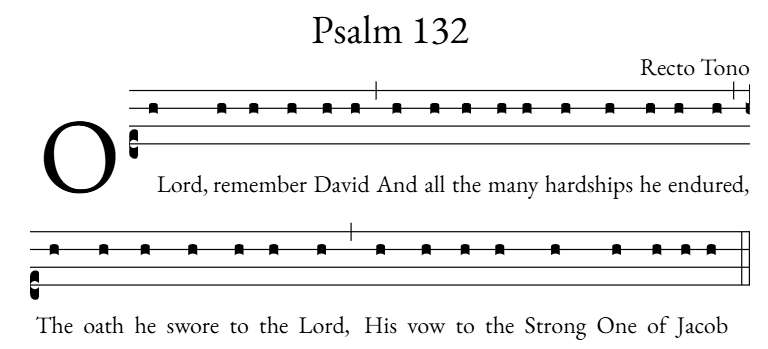
Recto Tono is a Latin phrase that means “Straight Tone”. This is the simplest form of chanting and involves reading and singing on a uniform note without embellishment. This form of chant makes the psalms easier to understand as the words are clearly spoken and singers are not distracted by changing tones. Below is the first strophe of Psalm 132 chanted recto tono.
Gregorian Psalm Tones
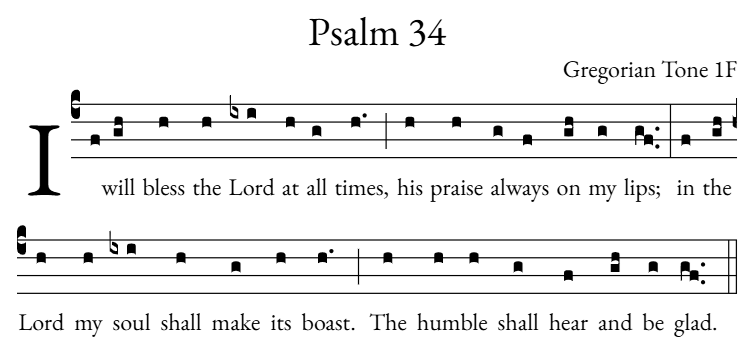
The classic Psalm Tones are the Gregorian Tones that can be found in many liturgical resources such as the Liber Usualis and the Antiphonale Romanum. There is one chant tone per Gregorian mode, and there are variations to the endings of each tone. The Gregorian Tones can be easily modified to fit almost any Psalm. For example, below are the neumes for Gregorian Tone 1F and the first strophe for Psalm 34.

I will bless the Lord at all times,*
his praise always on my lips;
in the Lord my soul shall make its boast.*
The humble shall hear and be glad.
Jones Tones & Murray Tones
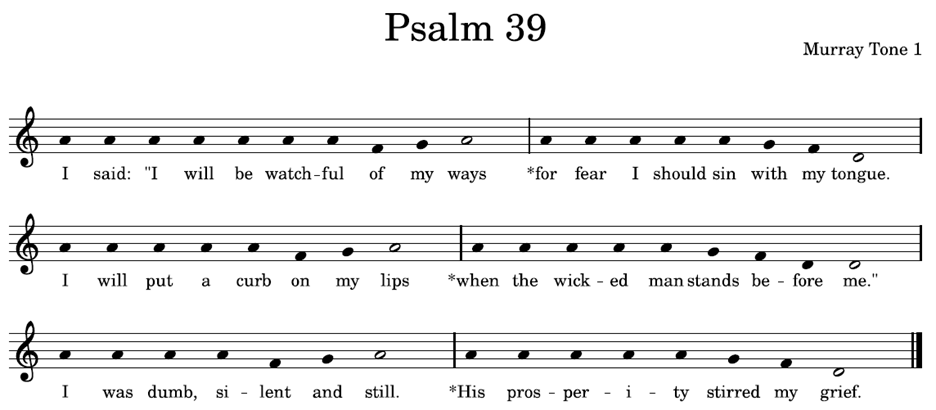
During the 1960s, following the reform of the Liturgy, vernacular language was incorporated in both the Mass and the Office. Since English words typically have fewer syllables than Latin, composers created English variations of the Psalm Tones. The Jones Tones are named after Rev. Percy Jones (1914-1992), an Australian Priest who studied music in Rome and the Abbey of Solesmes. Murray Tones are named after Dom Gregory Murray OSB (1902-1992) of Downside Abbey in England. Below is the first strophe of Psalm 39 in Murray Tone 1.

I said: “I will we watchful of my ways*
For fear I should sin with my tongue.
I will put a curb on my lips*
When the wicked man stands before me.”
I was dumb, silent and still.*
His prosperity stirred my grief.
Bevenot Tones
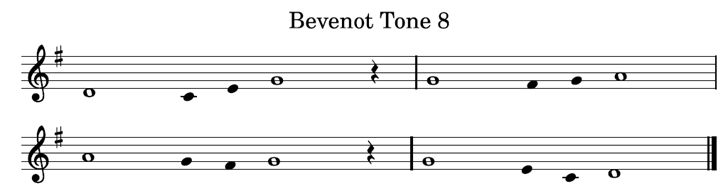
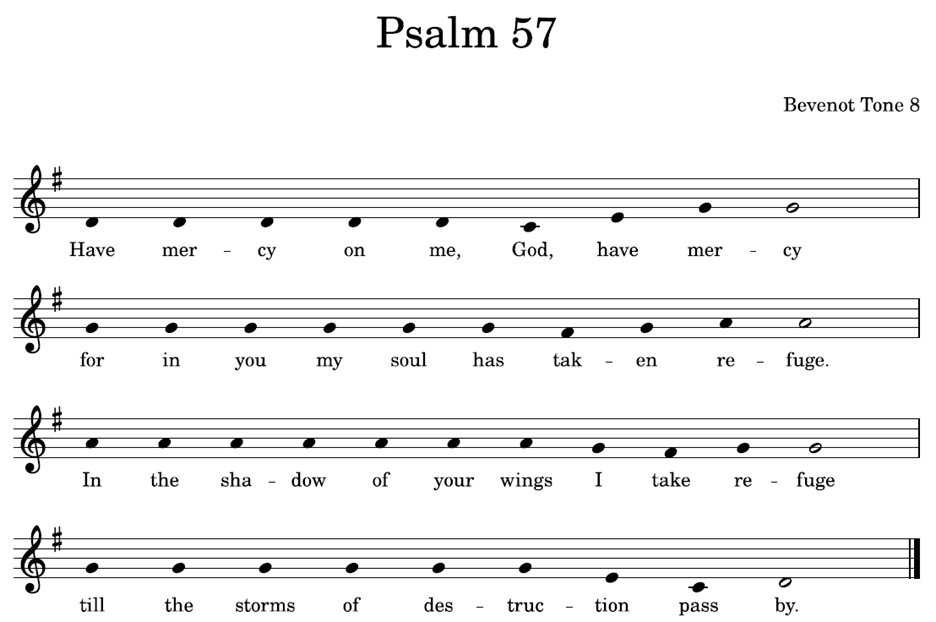
Another variation of the Psalms is the Bevenot Tones developed by Dom Laurence Bevenot OSB (1901-1990) of England. These Psalm tones are more complex than the Jones and Murray Tones and are designed to accommodate 4-line strophes. The tune for Bevenot Tone 8 and the first strophe of Psalm 57 is provided below.
Have mercy on me, God, have mercy
for in you my soul has taken refuge.
In the shadow of your wings I take refuge
till the storms of destruction pass by.
St. Meinrad Tones
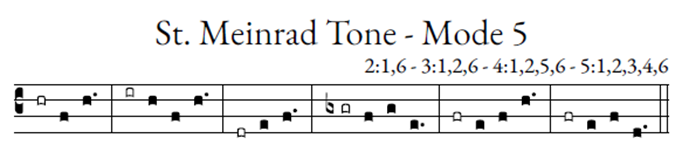
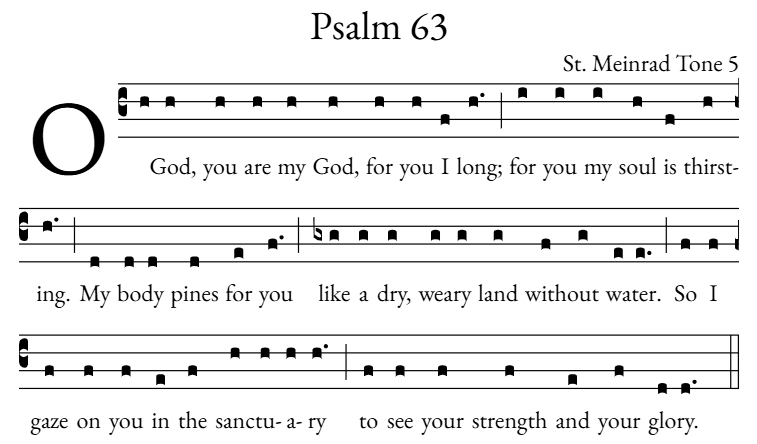
The St. Meinrad Tones were developed in the 1970s at the St. Meinrad Archabbey in southern Indiana. These are the most complex of the standard tone systems and can accommodate 6-line strophes. The St. Meinrad Tones were written as a collaborative effort by Fr. Columba Kelly OSB, Fr. Tobias Colgan OSB, and Fr. Samuel Weber OSB of St. Meinrad Archabbey, and Fr. Chrysogonus Waddell OCSO of the Gethsemani Abbey in Kentucky. The first strophe of Psalm 63 and St. Meinrad Tone 5 are provided below.
O God, you are my God, for you I long;
For you my soul is thirsting.
My body pines for you
Like a dry, weary land without water.
So I gaze on you in the sanctuary
To see your strength and your glory.
The Psalm tones are a wonderful way to add liturgical beauty to your prayers and enter deeper into the sung tradition of the Psalms. I hope that you too will find richness and depth in sung prayer. God bless you!