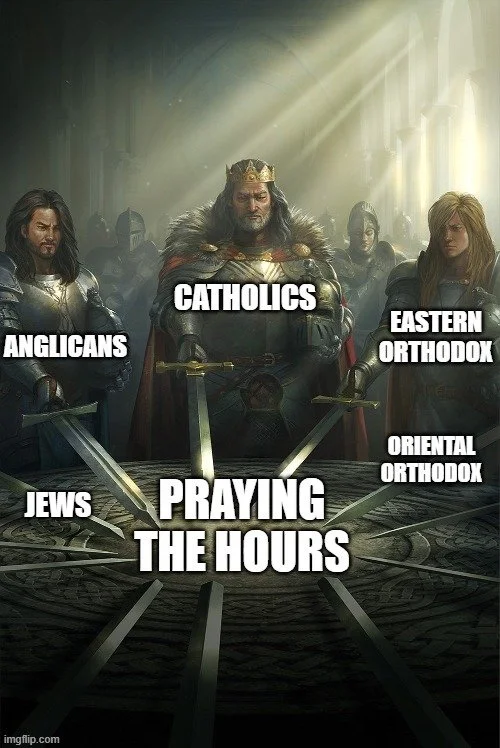
Prayer: From the Patriarchs to the Early Church
For many Christians outside of the Apostolic and “High Church” traditions, liturgical prayer at fixed hours of the day seems like an alien concept. Indeed, I recall a conversation with a Reformed Baptist friend who was hesitant to pray Vespers with me because he was concerned that it may have had non-Biblical and even pagan roots. Rest assured, this is not the case. The Canonical Hours is possibly the most Biblical way to pray as it is almost entirely composed of singing of the Psalms and reading from Scripture.
We’ll briefly explore the Biblical roots of the Liturgy, examples of Biblical fixed prayer, and the prayer rules of the Early Church.
The Liturgy in the Old Covenant
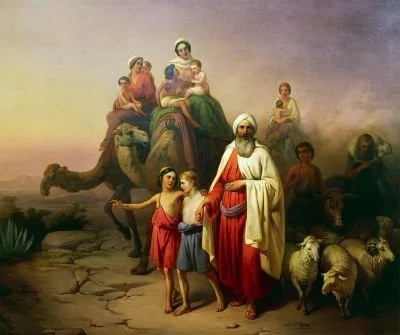
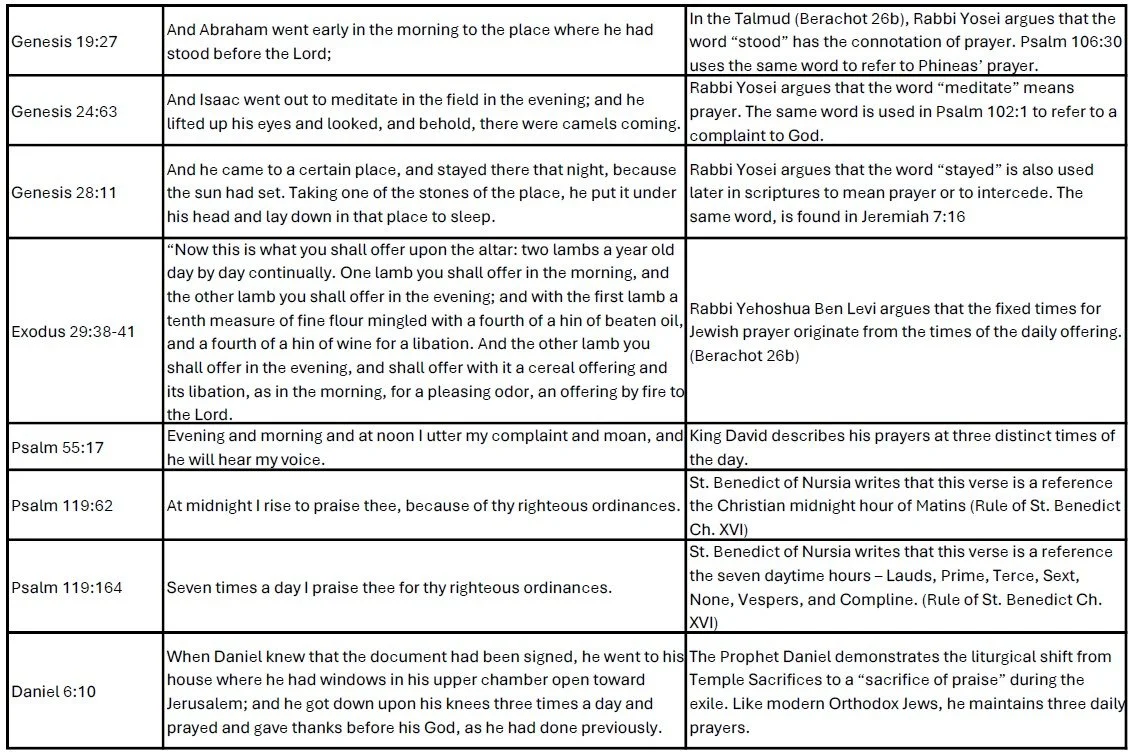
The root of fixed prayer comes from ancient Judaism. The custom of the Jews is to pray three times per day – Morning (Sharachit), Daytime (Mincha), and Evening (Maariv). Jewish Rabbis still debate the origin of these prayers. The Talmud identifies two intellectual sides in this debate (Berachot 26b). On one side, the Rabbis argue that the fixed hours of prayer were established by the Patriarchs. Morning prayer is associated with Abraham (Genesis 19:27), daytime prayer is associated with Isaac (Genesis 24:63), and evening prayer is associated with Jacob (Genesis 28:11).
On the opposing side of the debate, Rabbis point to the Tabernacle Sacrifices as the origins of fixed Jewish prayer. The sacrifices were instituted by Moses in Exodus 29:38-41 and prescribe daily sacrifices in the morning and in the evening. This daily liturgy would eventually be coupled with Psalms and prayers to form an early version of the Divine Office.
Daily Sacrifices continued at the Tabernacle until the Ark of the Covenant was moved to the Temple of Solomon (1 Kings 8:1-11) in 957 BC. When Jerusalem was sacked by the Babylonians in 587 BC, the Temple was destroyed and the Jews were carried off into exile. Without a temple to offer sacrifices, the Jews could only offer their prayers to God. An example of this was the prayers of the Prophet Daniel who prayed three times a day while facing Jerusalem (Daniel 6:10).
Other examples of daily prayer rules can be found in Psalms. Psalm 55 describes King David’s mournful prayers to God in the evening, morning, and noon (Psalm 55:17). The Jewish Rabbis point to King David’s example as a model for Jewish prayer. Psalm 119:62 describes the Psalmist rising at midnight to praise God and his law, and later in Psalm 119:164, the Psalmist praises God seven times per day. St. Benedict of Nursia and other early Church Fathers refer to Psalm 119 as the basis for the seven traditional Christian Hours of prayer.
Liturgy in the New Covenant
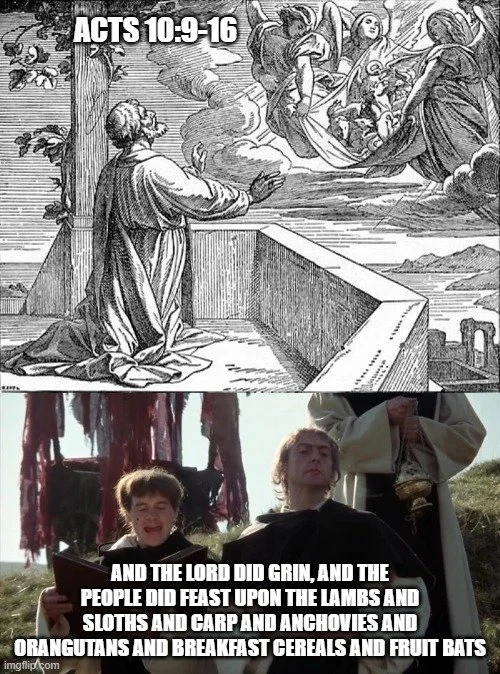
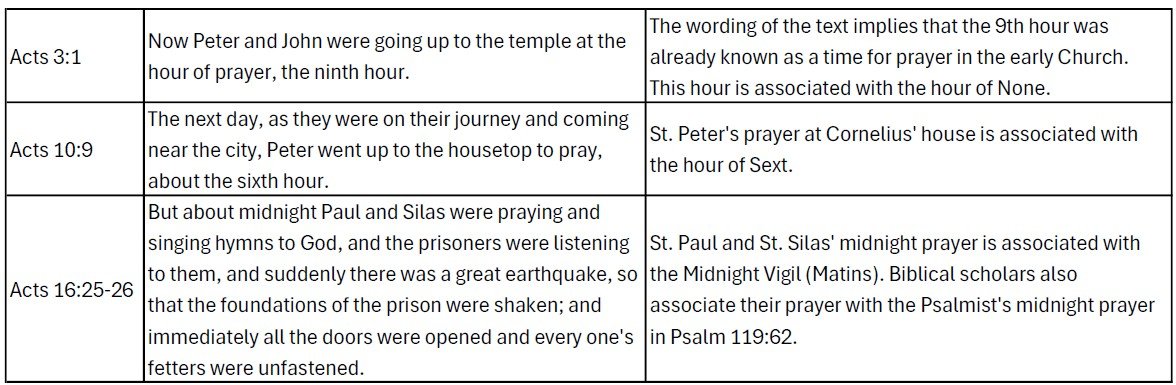
The first Christians were culturally and ethnically Jewish, and they retained their Jewish form of prayer. Examples of the Apostles praying at fixed hours of the day are recorded in Acts. In Acts 3:1, St. Peter and St. John pray at the temple “at the hour of prayer, the ninth hour.” In addition, When St. Peter visits the household of Cornelius and receives the Vision of the Sheet and the Animals, he withdraws to the roof and prays on the sixth hour (Acts 10:9).
When St. Paul and St. Silas were beaten and arrested for exorcising a spirit from a slave girl, they still rise at midnight to sing hymns and pray before God sends an earthquake to break them free. The Church Fathers associated the prayers of the Apostles with the Canonical hours of None (9th Hour), Sext (6th Hour), and Matins (Midnight Vigil) respectively. Explicit rules for Christian prayer would not be formally codified until the rise of Monasticism in the 4th Century, but the early Christians were dedicated to rules of prayer since the beginning.
The Patristic Era
The writings of the Church Fathers provide valuable insight to the development of distinctive Christian prayer. In one of the earliest non-Biblical Christian writings, the Didache (Late 1st Century), the anonymous author instructs Christians to pray the Lord’s Prayer three times per day (Didache 8:2-3). Unfortunately, the author does not provide further details of daily Christian prayer.
“Do not pray like the hypocrites, but rather as the Lord commanded in His Gospel, like this: Our Father in heaven, hallowed be Your name. Your kingdom come. Your will be done on earth, as it is in heaven. Give us today our daily bread, and forgive us our debt as we also forgive our debtors. And bring us not into temptation, but deliver us from the evil one (or, evil); for Yours is the power and the glory for ever. Pray this three times each day.”
In Apostolic Tradition by St. Hippolytus of Rome (165 – 235 AD), he lists six canonical hours of prayer. In the morning, he instructs the faithful to wake early, ritually wash themselves, and pray (Apostolic Tradition 35:1). St. Hippolytus also lists the daytime prayers of the 3rd Hour, the 6th Hour, and the 9th Hour and associates each hour to the commemoration of Christ being nailed to the Cross, the Great Darkness during the Crucifixion, and death of Christ and the piercing of the lance respectively. (Apostolic Tradition 36:2-6). He instructs Christians to pray before bed and rise at midnight for the vigil prayers.
In Origen’s (185 – 253 AD) work, On Prayer, he instructs Christians to pray three times per day – in the morning, midday, and evening. Origen cites Daniel as a model for three-fold prayer in the Old Testament and further cites Psalm 5:3 and Psalm 141:2 as the precedent for morning and evening prayers, and St. Peter’s midday prayer in Acts 10:19.
Tertullian’s (155 – 220 AD) similarly named work, On Prayer recommends that the three daily prayers be prayed at the third, sixth, and ninth hour. Tertullian cites Daniel as the model of prayer and connects praying three times daily as paying homage to the Holy Trinity.
The Sayings of the Desert Fathers records a story about St. Epiphanius of Cyprus (310 – 403 AD) who received a letter that he received from a Palestinian monastery. The monks of the monastery wrote to him that they were maintaining their rule of praying the third, sixth, and ninth hour each day. St. Epiphanius reproved the monks for neglecting the other prayers of the day and encouraged them to pray the psalms continuously.
The most comprehensive early description of the Divine Office comes from St. Benedict of Nursia’s (480 – 547 AD) Rule of St. Benedict. In his rule, St. Benedict cites Psalm 119:62 and Psalm 119:164 to direct his monks to pray a midnight vigil (Matins) and seven daytime offices (Lauds, Prime, Terce, Sext, None, Vespers, and Compline) (Rule of St. Benedict Chapter XVI).
Other chapters of St. Benedict’s Rule include instructions on what psalms to use depending on the hour, day, and season. Remarkably, many of the instructions are retained in the modern liturgy such as the singing of the Te Deum during feast days, and the use of Psalm 95 as the invitatory psalm of each day. Under the Benedictine rule, the entire psalter (all 150 psalms) are prayed within a week.
In Conclusion
The Canonical Hours have a long history in both Jewish and Christian spiritual life. Both the prayers and the precedent for these prayers are drawn directly from Scripture, and it is a tradition that bridges the Christians of today to our Apostolic forefathers. I encourage every follower of Christ to consider taking up this ancient practice to grow closer to God.
Dominus nos benedicat, et ab omni malo defendat, et ad vitam perducat aeternam. Amen.
*May the Lord bless us, protect us from all evil, and bring us to everlasting life. Amen